
Data Warehouse
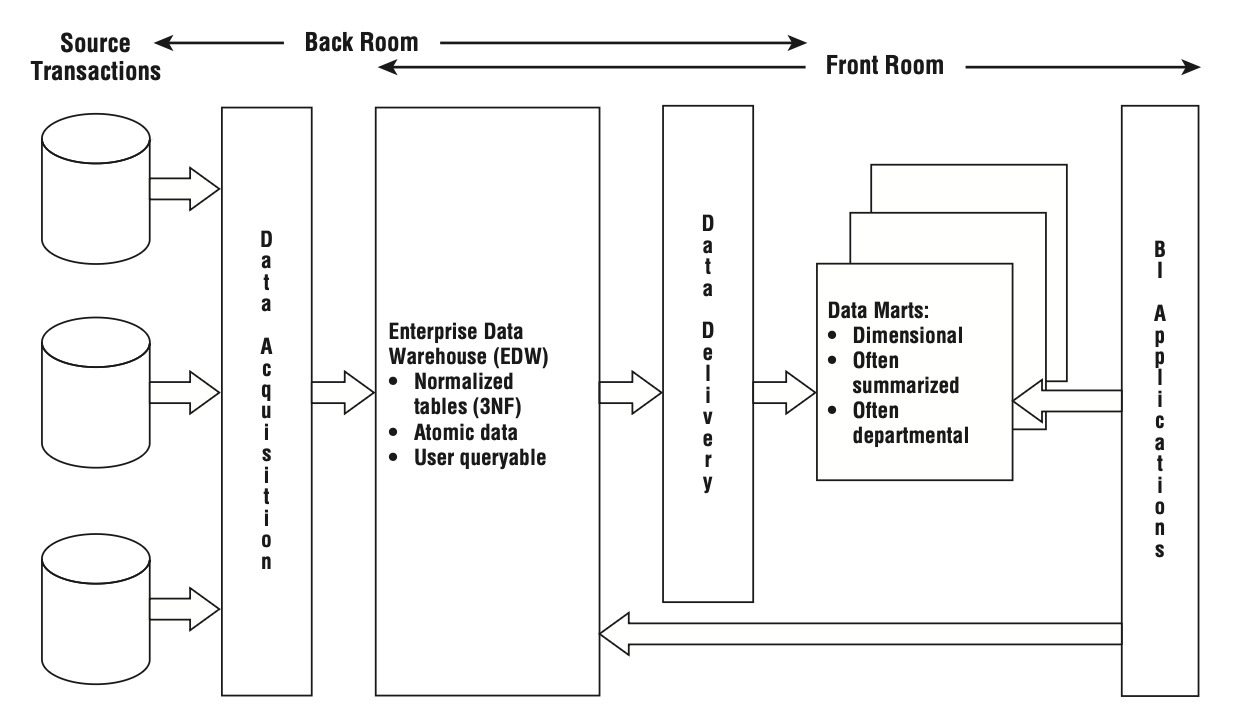
Hub-and-Spoke CIF (Inmon Architecture)
Championed by Bill Inmon (often called the "father of data warehousing"), the Corporate Information Factory (CIF) represents a top-down approach.
- Structure: Data from source systems is extracted, transformed and loaded into a centralized, highly normalized (typically 3rd Normal Form) Enterprise Data Warehouse. This EDW acts as the atomic-level single source of truth (the "Hub").
- Data Marts: End users and BI applications do not query the EDW directly. Instead, data is extracted from the EDW to populate specialized departmental data marts (the "Spokes"). These data marts can be dimensional or relational.
- Pros: Provides a rigorous, integrated and highly consistent enterprise-wide foundation. The normalized EDW is excellent for complex, cross-functional data integration.
- Cons: Requires massive upfront planning and effort before delivering any business value. Building and maintaining a highly normalized enterprise model is notoriously slow and complex.
Independent Data Mart Architecture
In this architecture, data is extracted from operational source systems and loaded directly into standalone, isolated data marts designed for specific departments or business functions (e.g., a Sales Data Mart, a Finance Data Mart).
Kimball's DW/BI Architecture
Developed by Ralph Kimball, this architecture takes a bottom-up approach focused entirely on dimensional modeling and delivering immediate business value.